New data from the Cassini–Huygens shows that Saturn’s magnetic cusps are mostly clustered on one side instead of being evenly spread out. This surprising finding suggests that Saturn’s fast rotation changes how its magnetic field interacts with space, challenging what scientists previously believed.
Let’s say two planets are being bombarded by the same cosmic wind. Our first obvious expectation would be that they’d react the same way, but in reality it’s not so.
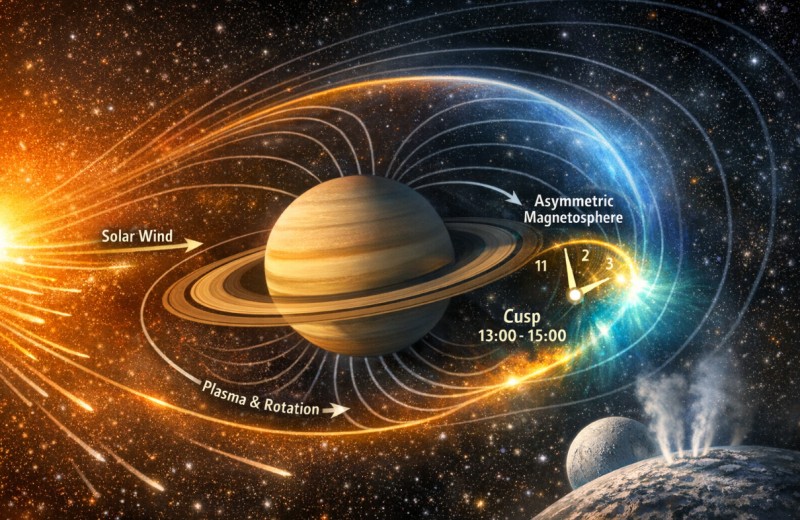
Scientists using data from NASA’s Cassini spacecraft have discovered that its magnetosphere, the invisible magnetic shield protecting the planet from the solar wind, doesn’t work like Earth’s at all. While Earth’s cusps (funnel-shaped regions where particles can enter the magnetosphere) are neatly centered around noon, Saturn’s are stretched and skewed toward the afternoon and evening. Some cusps even appear near midnight, something virtually never seen on Earth.
This isn’t a small quirk, it’s a fundamental revelation about how rotating planets interact with the universe around them. As per the research team,
“The cusp is like a door. At Earth, that door opens toward the sun at noon. At Saturn, the door has been pulled sideways by the planet’s spin”.
Earth’s Structured Magnetosphere vs. Saturn’s Dynamic System
To understand why this matters, we need to zoom out and look at the bigger picture.
Earth’s magnetosphere is relatively straightforward, the solar wind pushes against our magnetic field like water against a dam. Magnetic reconnection, when field lines snap and reconnect, happens mostly at the subsolar point (the noon-facing side), where the sun’s influence dominates. This creates cusps on both the morning and afternoon sides in a neat, symmetrical pattern that scientists have studied for decades.
Saturn, however, operates under completely different rules.
Unlike Earth, Saturn rotates extremely fast (one rotation every 11 hours), and its interior constantly feeds charged particles into the magnetosphere through Enceladus, one of its moons with geysers of water ice. These internal sources mean Saturn’s magnetosphere is self-driven rather than purely pushed by the solar wind. It’s the difference between a dam responding to river flow (Earth) and a rotating turbine generating its own circulation (Saturn).
Why Saturn’s Spin Shifts Everything Sideways
Let’s imagine spinning a magnet very quickly while the wind blows past it. The spinning would distort the wind’s effect, pushing the wind pattern sideways, that’s what’s happening at Saturn.
The new research, published in Nature Communications, identified 67 cusp events using Cassini data from 2004 to 2010. Of these, most clustered in the post-noon sector (around 13–15 local time), with some extending into the post-dusk region, this was only theoretically predicted before. In the words of one of the researchers,
“This is like finding a hidden continent on a familiar map. We’ve studied Earth’s cusps for fifty years, but Saturn’s cusp distribution tells us something entirely new about rapidly rotating systems”.
Breaking Down the Discovery: What Cassini Actually Found
Saturn’s magnetic environment has long puzzled scientists, but the Cassini mission offered a rare, close-up look. What it uncovered challenged existing theories and revealed unexpected behavior in the planet’s magnetic shield. Here’s what the data actually showed.
The Smoking Gun: Magnetosheath Electrons
When Cassini flew through one of these cusp regions on January 31, 2009, its instruments detected electrons in the 10–100 eV energy range. Scientists recognize this as a clear sign of magnetosheath plasma, the squashed, turbulent solar wind that sits just outside a planet’s magnetic shield.
So what does that mean?
Generally, these particles didn’t originally belong inside Saturn’s magnetic bubble. They came from the solar wind and had just made their way in. These were the fresh arrivals, sneaking past the planet’s defenses right as Cassini flew through.
The spacecraft also recorded:
- Ion dispersion patterns: particles arriving in sequence by energy.
- Bidirectional electron distributions: particles flowing both toward and away from the planet along magnetic field lines.
- Magnetic field depressions: weakened magnetic regions.
All of these signatures matched the theoretical definition of a magnetospheric cusp, but in an unexpected location.
The Statistical Bombshell
Earlier studies had only spotted about 10–11 of these cusp events at Saturn. In this new analysis, scientists found 67, which is a huge jump.
The team adjusted their results based on how much time Cassini–Huygens actually spent in different regions of space. In simple terms, they made sure the numbers were fair, so areas where Cassini lingered longer didn’t look artificially more active just because they were observed more.
When they did the math:
- 13–16 local time (afternoon): 0.028 cusp events per hour
- 8–11 local time (morning): 0.006 cusp events per hour
The afternoon side showed nearly five times more cusp activity than the morning side.
This wasn’t random noise or spacecraft trajectory bias. This was a real, systematic asymmetry baked into Saturn’s magnetospheric structure.
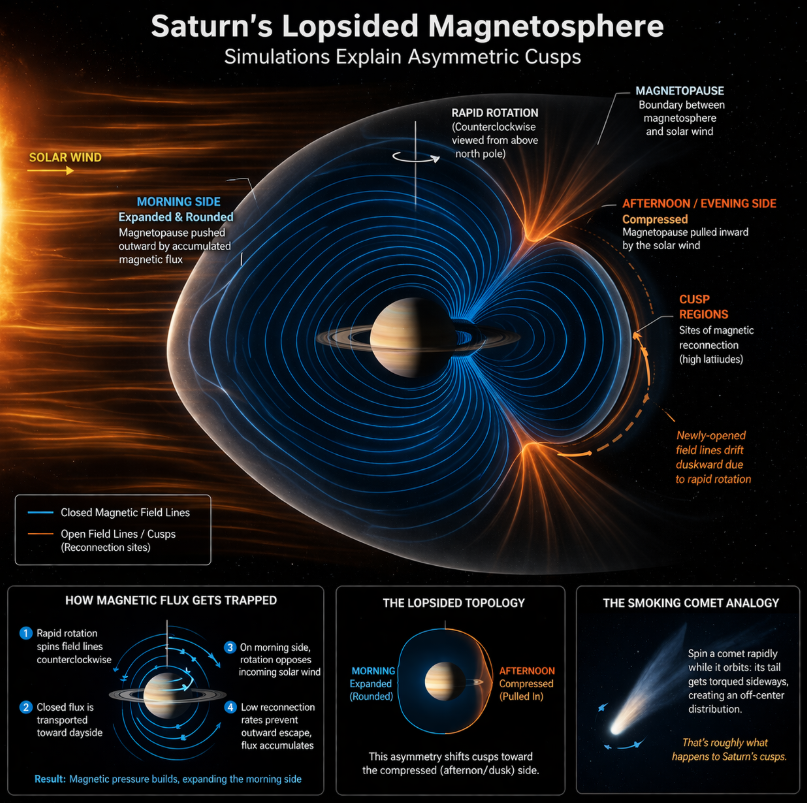
How Magnetic Flux Gets Trapped
So what’s driving this uneven behavior across Saturn’s magnetosphere? To understand the shift, we need to look at how magnetic flux builds up and moves within the system.
The Flux Accumulation Picture
Saturn’s rapid rotation acts counterintuitively, it causes closed magnetic field lines to accumulate on the morning side of the magnetosphere. Here’s the sequence:
- Rapid rotation spins magnetic field lines in a counterclockwise direction (when viewed from above the north pole)
- These spinning field lines transport closed flux toward the dayside (the sunlit hemisphere)
- On the morning side, this motion opposes the incoming solar wind
- The magnetopause boundary can’t move outward because magnetic reconnection rates are low on the dawn side
- Magnetic pressure builds up, pushing the magnetopause outward by 1–2 Saturn radii more on the morning side than the afternoon side
This creates an asymmetric magnetosphere, expanded on the morning, while, compressed on the afternoon.
Since cusps must anchor to the open-closed field line boundary, they naturally get shifted toward the compressed (afternoon/dusk) side.
The Smoking Comet Analogy
Let’s say a comet with a tail pointing away from the sun. Now spin that comet extremely fast while it orbits. The tail doesn’t just point away, it gets torqued sideways by the rotation, creating an off-center distribution. That’s roughly what’s happening with Saturn’s cusps.
Cassini’s Journey: From Discovery to Data
The researchers examined three instruments aboard Cassini:
| Instrument | What It Measures | Key Finding at Saturn’s Cusp |
| MAG (Magnetometer) | Magnetic field strength and direction | Stable magnetic field, ruling out magnetosheath region |
| CAPS-ELS (Electron Spectrometer) | Electron energy and distribution | Enhanced 10–100 eV electrons (magnetosheath signature) |
| CAPS-IMS (Ion Spectrometer) | Ion energy and composition | Dispersed ion signatures, indicating reconnection |
These weren’t just point measurements. Over seven years, Cassini’s orbital trajectory gave scientists a unique vantage point, repeatedly crossing Saturn’s high-latitude regions at different local times.
Computer Simulations: Seeing the Invisible
To understand why these cusps distribute the way they do, researchers ran high-resolution magnetohydrodynamic (MHD) simulations. It’s more like creating a digital twin of Saturn’s magnetosphere.
The simulations revealed that Saturn’s magnetopause (the boundary between the magnetosphere and the solar wind) has a distinctly lopsided shape:
- Morning side: More rounded, expanded outward
- Afternoon/evening side: More compressed, pulled inward
This topology forces magnetic reconnection, the key process that creates cusps, to occur predominantly at high latitudes rather than at the subsolar point. And crucially, the newly-opened field lines then drift duskward because of Saturn’s rapid rotation.
Saturn Isn’t Alone, Jupiter Shows the Same Strange Pattern
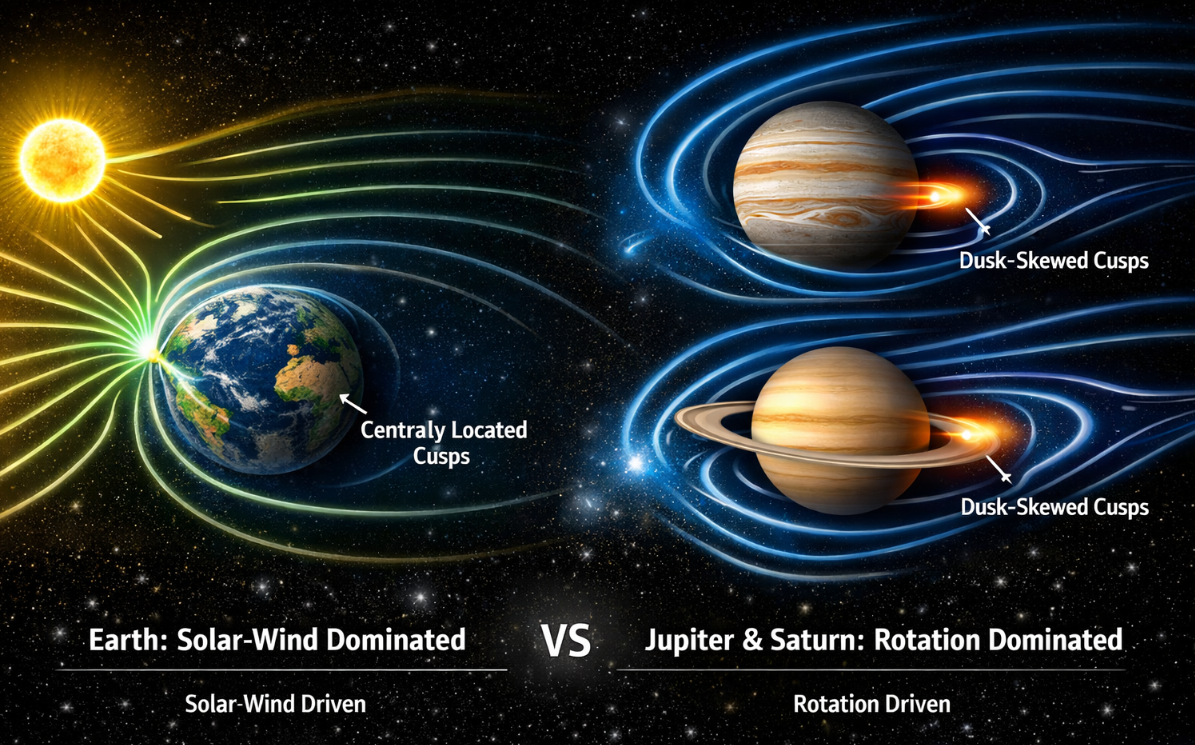
Interestingly, Saturn’s cusp pattern mirrors what was recently discovered at Jupiter. Both rapidly rotating giants show:
- Afternoon/dusk-concentrated cusp distributions
- High-latitude-dominated magnetic reconnection
- Internally-driven magnetospheric circulation
This suggests a universal principle: rapid rotation fundamentally reshapes how planets interact with the solar wind.
Earth’s magnetosphere is solar-wind-dominated, Jupiter and Saturn are rotation-dominated. And this simple distinction explains why their cusps look completely different, despite being the same physical phenomenon.
Why This Matters Way Beyond Saturn
So this isn’t just an interesting quirk of Saturn, it points to something much bigger. Once you zoom out, the implications start to reach far beyond a single planet.
For Planetary Science
As astronomers discover exoplanets around distant stars, many will be rapidly rotating gas giants. Knowing how such rotation reshapes magnetospheres helps us understand:
- Where potentially habitable moons might exist
- How star-planet magnetic interactions work
- What “habitable zones” might actually look like
For Understanding Space Weather
Saturn’s magnetosphere is a natural laboratory for understanding magnetic reconnection in extreme conditions. What we learn here could improve our models of Earth’s magnetosphere and our ability to predict space weather.
For Technology
Spacecraft and satellites traversing planetary magnetospheres need better maps. The discovery that Saturn’s cusps extend into unexpected regions means future probe missions require updated models.
The Takeaway
What makes this research genuinely profound is what it reveals about the universe’s flexibility.
We often think of physics as universal, the same laws everywhere and that’s true. But those laws produce wildly different outcomes depending on context. Spin a planet faster, add some internal heat, and the entire geometry of its interaction with the cosmos changes. One researcher explained,
“The cusp is just a symptom. What we’re really discovering is that rotation-dominated and solar-wind-dominated systems follow fundamentally different recipes”.
This suggests a hierarchical understanding of planetary magnetospheres:
- Very slow rotation → Solar wind dominates (like Earth)
- Moderate rotation → Mixed effects (like Uranus)
- Rapid rotation → Rotation dominates (like Jupiter and Saturn)
- Extremely rapid rotation → Perhaps exotic magnetospheric topologies we haven’t seen yet
The Cassini mission ended in 2017, but the data keeps giving. However, significant questions remain, like:
- Can we directly observe Saturn’s magnetopause reconnection in progress?
- How do seasonal changes in Saturn’s atmosphere affect magnetospheric dynamics?
- Do other exoplanet systems show similar rotation-driven asymmetries?
- How does Enceladus’s plasma output modulate cusp occurrence rates?
Future missions, whether to Saturn’s moons like Enceladus or to Jupiter, will test these predictions.
Saturn’s asymmetrical cusp distribution is a reminder that our solar system is far more diverse and intricate than textbook diagrams suggest. We thought we understood magnetospheres. Earth taught us the basic rules but Saturn, spinning at tremendous speeds and fed by internal plasma sources, played a completely different game.
The universe doesn’t simplify easily, it complexifies. And that complexity, once decoded, reveals deeper truths about how worlds interact with their cosmic environment.
As one team member reflected,
“If we find rapidly rotating exoplanets light-years away, we now know their magnetospheres won’t work like Earth’s. They’ll be shaped by the same physical principles, but expressed in ways we’re only beginning to appreciate”.
That’s the power of science, each discovery rewrites our mental map of what’s possible.
Research cited: Xu et al., “Dawn-dusk Asymmetrical Distribution of Saturn’s Cusp”, Nature Communications, 2026.
Frequently Asked Questions
1. What is Saturn’s magnetosphere?
Saturn’s magnetosphere is a magnetic bubble surrounding the planet that protects it from the solar wind, a stream of charged particles flowing from the Sun. It is generated by internal processes deep inside Saturn and influenced by both solar wind and material from its moons.
2. What are magnetospheric cusps?
Magnetospheric cusps are funnel-shaped regions where charged particles from the solar wind can directly enter a planet’s magnetic field. These regions are key sites for magnetic reconnection, where magnetic field lines break and reconnect, allowing energy and particles to flow inward.
3. How are Saturn’s cusps different from Earth’s?
On Earth, cusps are symmetrically located around the noon (sun-facing) region. On Saturn, however, Cassini data shows that cusps are skewed toward the afternoon/dusk side and can even extend toward midnight—indicating a strongly asymmetric magnetosphere.
4. Why is Saturn’s magnetosphere asymmetric?
Saturn’s rapid rotation (about 10–11 hours per day) and internal plasma sources—especially from its moon Enceladus—drive circulation within the magnetosphere. This causes magnetic flux to accumulate unevenly, expanding the morning side and compressing the afternoon side.
5. What role did the Cassini–Huygens mission play?
Cassini orbited Saturn from 2004 to 2017 and provided the first long-term, in-depth measurements of its magnetic environment. Its instruments detected plasma signatures, magnetic field changes, and particle distributions that revealed the unusual cusp behavior.
6. What evidence confirmed the existence of Saturn’s cusps?
Cassini detected:
- Electrons in the 10–100 eV range (magnetosheath origin)
- Ion dispersion patterns
- Bidirectional electron flows
- Magnetic field depressions
These are all classic signatures of cusp regions formed by magnetic reconnection.
7. How many cusp events were observed at Saturn?
Earlier studies identified about 10–11 cusp events. New analysis of Cassini data identified 67 events, showing that cusps are far more common and systematically distributed than previously thought.
8. What causes the shift toward the afternoon side?
Magnetic flux builds up on the morning side due to rotation opposing the solar wind. This creates pressure that expands the magnetosphere on one side and compresses it on the other, shifting reconnection—and therefore cusps—toward the afternoon/dusk region.